Paper Notes: Converting Manual Work into Human-Robot Teamwork
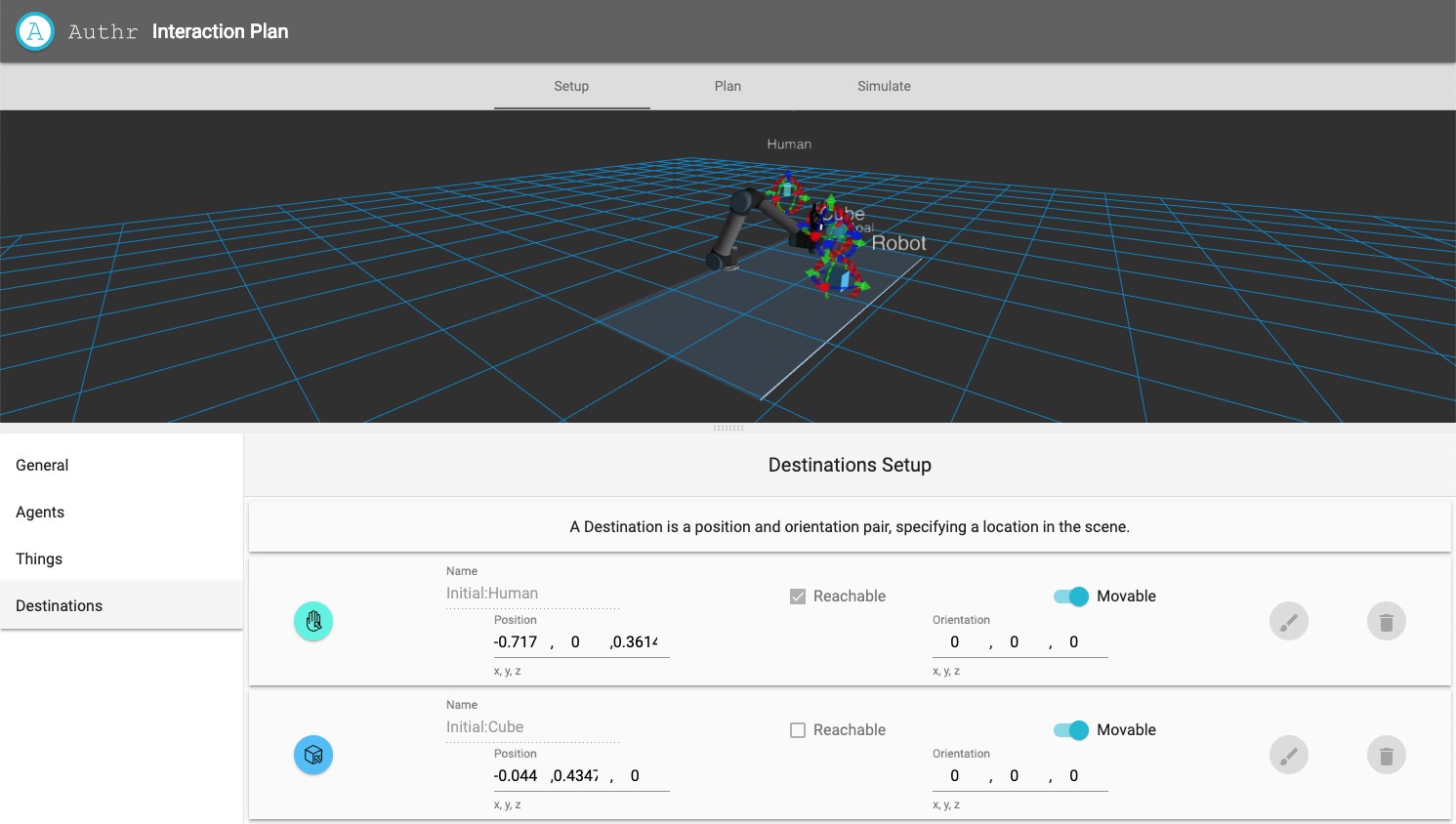
Most manufacturing work was designed for a pair of human hands. Put a cobot on the line and someone has to take that work apart and decide which pieces go to the robot and which stay with the person. That someone is usually a manufacturing engineer with no robotics background, and the hard part isn’t getting the robot to work. It’s reworking a task built for human hands into something a human-robot team can actually do together.
During my time at the People and Robots Laboratory at UW-Madison, we built Authr, a task authoring environment that helps manufacturing engineers do exactly that. Instead of needing robotics expertise, engineers get a visual drag-and-drop interface for breaking manual work down into collaborative plans.
The core idea is to decompose work into plans, tasks, and therbligs (atomic motion primitives from classical industrial engineering), then let Authr handle allocating who does what. Once a plan is laid out, the system simulates the full sequence in a ROS-based environment so engineers can verify everything before touching real hardware. It supports Universal Robots (UR3, UR5, UR10) and the Franka Emika Panda.
We ran two user studies evaluating the tool. Authr proved usable and effective as an authoring interface; the assistive allocation methods meaningfully improved how participants designed complex collaborative plans.
This was joint work with Andrew Schoen, Mathias Strohkirch, and Bilge Mutlu, published at ACM UIST 2020. Source code is on GitHub.
Papers: