Táltos-oid ~ The Sixth Finger, Seven Years On
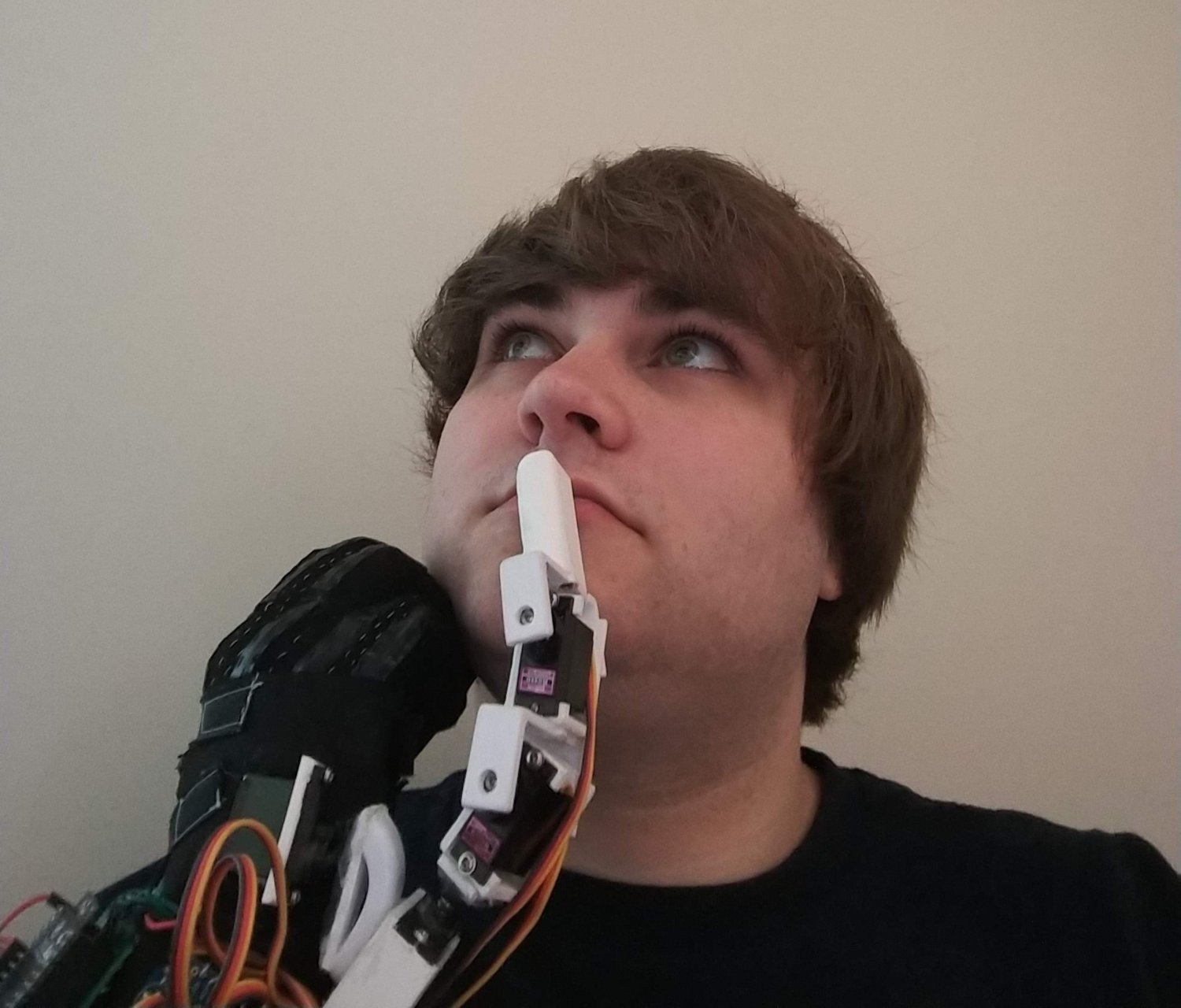
TL;DR: In 2019 I built a robotic sixth finger, named it after a Hungarian shaman, and then, during debugging, put it inside a plastic box because I had decided it was trying to get away from me. I have been thinking about that second part ever since.
What it was
Táltos-oid was a supernumerary robotic finger. Not a prosthetic, not a replacement. An extra digit, worn next to the pinky of my left hand, mirroring the position and joint structure of a biological thumb.
The build, briefly. Four degrees of freedom, 3D printed, a high-torque micro servo sitting at every joint, all of it strapped to a soft neoprene brace. The sensing was a glove I sewed my own fabric flex sensors onto. Those fed an ESP32, which relayed everything to a laptop, where a neural net trained on my hand postures decided where the finger should go. Everything else, including the parts that broke and why, is in the build write-up (please read it if you haven’t; this post will stay right here for you).
The firmware and ROS code are on GitHub (the laptop-side Python never made it in and is lost). The original weekly build logs survive, warts and all. The course site itself has gone dark, so they live in the Wayback Machine now, the weekly posts and the final write-up both. They’re filed under InGlove, a gesture-control glove I started the semester on as a team project before splitting the finger off as my own.
The name
I did not call it Táltos-oid for the aesthetics. From my weekly post in April 2019, when I finally landed on it:
I have found a name for my project that captures the essence of this step in embracing my transhuman philosophy. […] Táltos comes from Hungarian mythology and is a shaman that has innate supernatural power and can be identified by several possible abnormalities. The one I am drawing upon is that a Táltos can be identified by an extra finger. What I like about this name is that this device, poetically, allows me to take a step toward transcending my humanity.
Let’s briefly touch on the folk story. A táltos was a person the spirits had picked out, and the sign was something odd at birth. Born with teeth, born in the caul, born with white hair, or born with a sixth finger. A táltos could go into a trance, heal, lift curses, and see what was hidden. The gift couldn’t be learned or taught. The spirits conferred it, and by some tellings it went away if the extra bone was broken or lost. A fun fact. The painted ceiling of the church at Székelyderzs had a six-fingered figure on it, and a later renovation fixed it to five (maybe AI generated art is trying to tell us something).
If you want more, start with the Wikipedia pages on the táltos and on Hungarian mythology. Vilmos Diószegi wrote the scholarly work on what survived of Hungarian shamanism, though it was never translated.1 Tekla Dömötör and Éva Pócs cover the táltos in English.2
The breakdowns
The technical write-up is the other post. Sometimes the most interesting things in user testing are the breakdowns. Here are the most salient ones.
The cabinet
Early on, before the finger was mounted, I wore just the base, the neoprene-and-leather brace with no actuator. I reached into a cabinet and got caught on an edge.
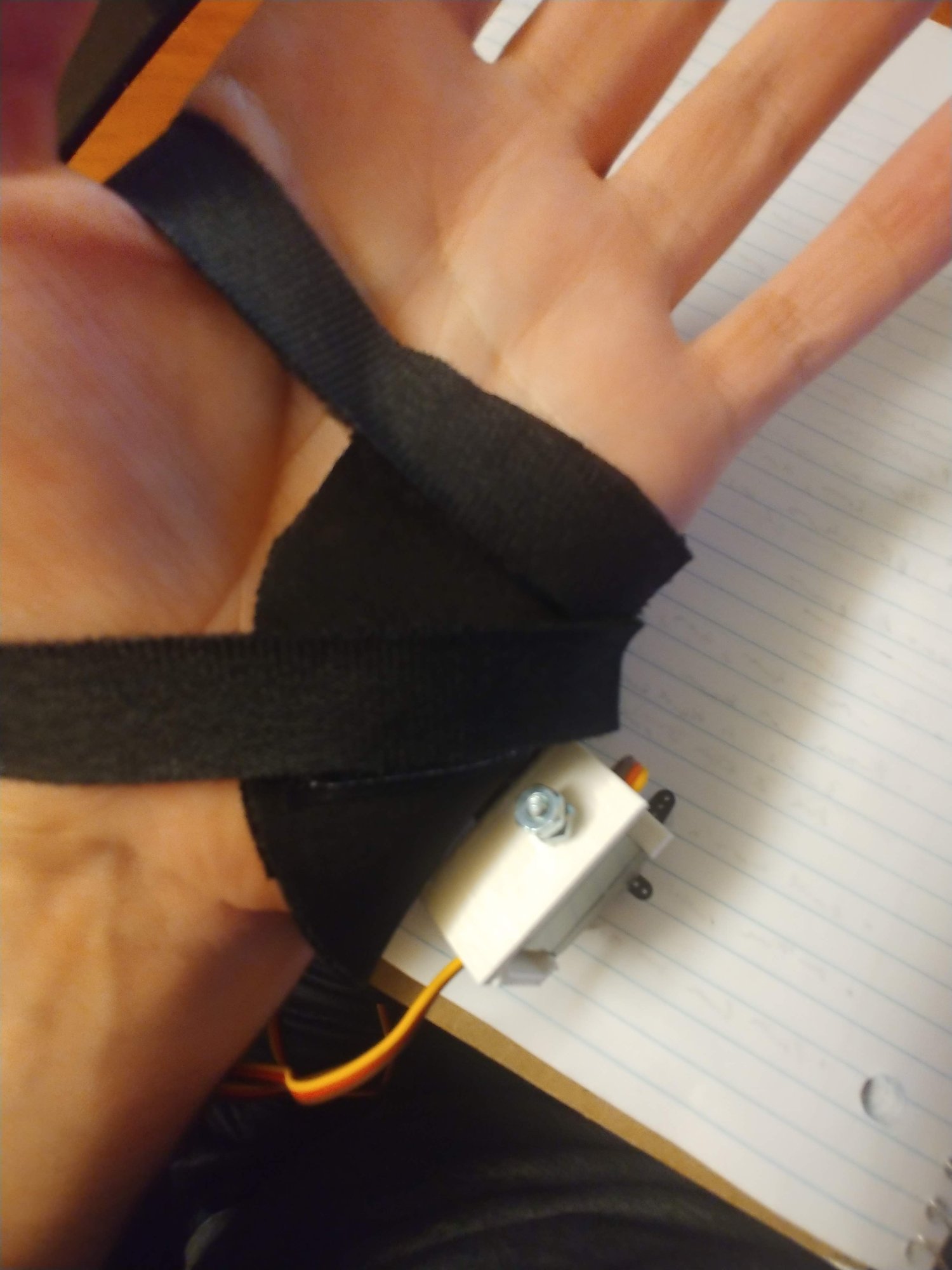
In the log I called it a moment of panic. My body had not added the base to its map of itself yet, so there was a piece of geometry on me that my proprioception did not know about, and the cabinet found it first. Nothing got damaged, me included. It just startled me more than it should have.
“It feels very weird when the servo moves”
The specific weirdness isn’t the mass or the pressure. I adapted to those within minutes. It’s that a thing attached to my hand initiates motion that I did not initiate. Even when the motion is correct (it often wasn’t). Especially when the motion is correct, actually, because a wrong movement reads as a bug and a right movement reads as otherness.
The box
The servos ran straight off the ESP32 and shared its USB supply. Every time a servo drew current the rail sagged and took the microcontroller’s logic level down with it. The finger jittered constantly and every so often spasmed, and it made me wonder whether the thing was safe to put on my hand at all. The full story is in the build post.
So I put it in a plastic box while I debugged.
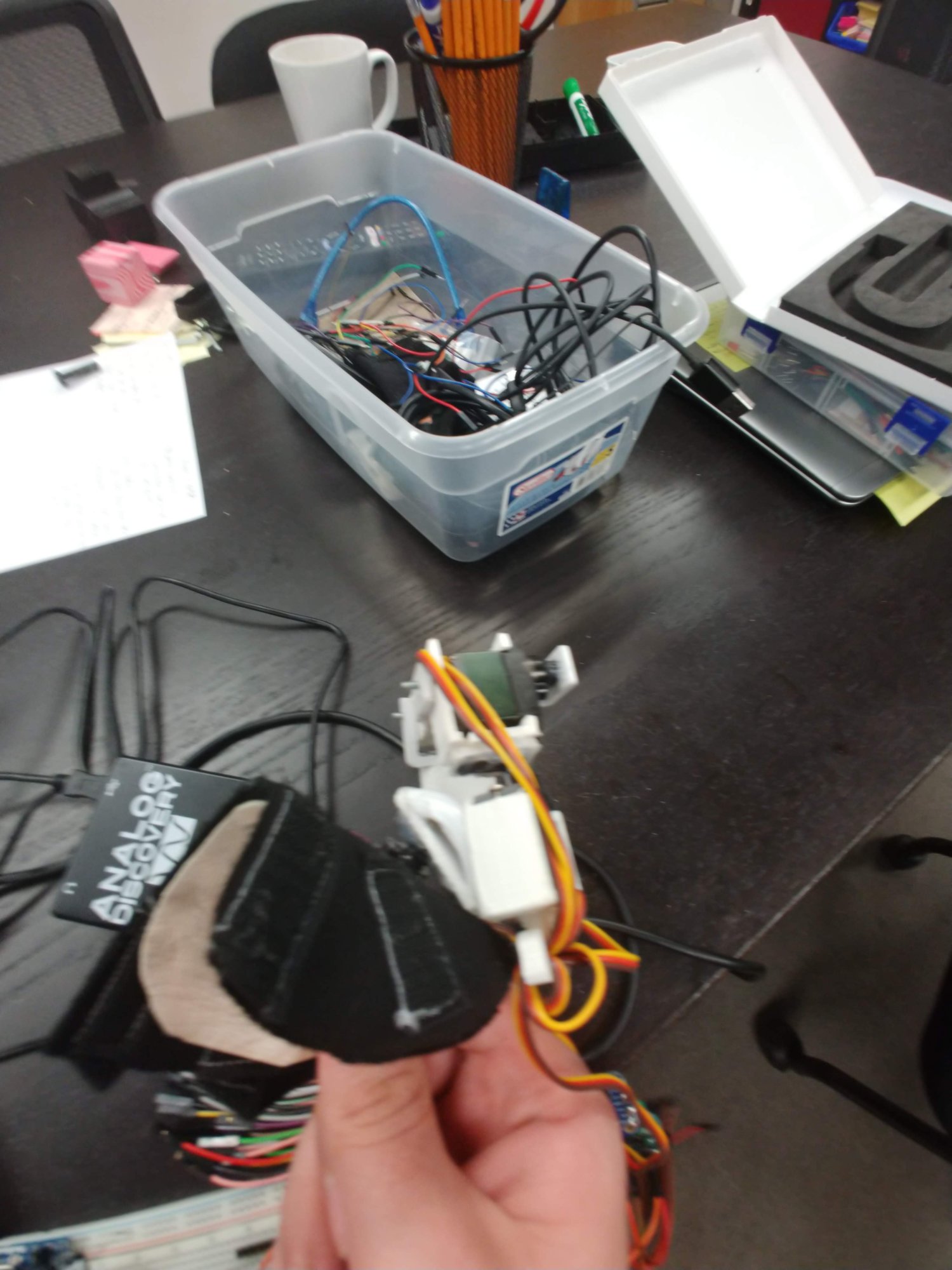
And here is how I wrote it down at the time.
I ended up banishing the finger to a plastic box so that it would not make a freedom-focused break for the edge of the desk while I was debugging.
I knew what was wrong after a minute of thinking. Voltage sag, entirely deterministic. The fix was moving the servos onto their own I2C driver board with its own supply, where they could no longer drag the microcontroller down with them.
And yet I still considered it an escape attempt. This emerged while I was in the middle of my work with it. I assigned malfunctioning actuators with intent and an unaligned objective. I built the thing. I knew every joint in it.
And then the glove dissolved
The glove failed at the public showcase. The postmortem is in the build post, but the short version is that sweat dissolved the conductive ink I’d used as glue, and the threads had picked up resistance from rubbing on my skin.
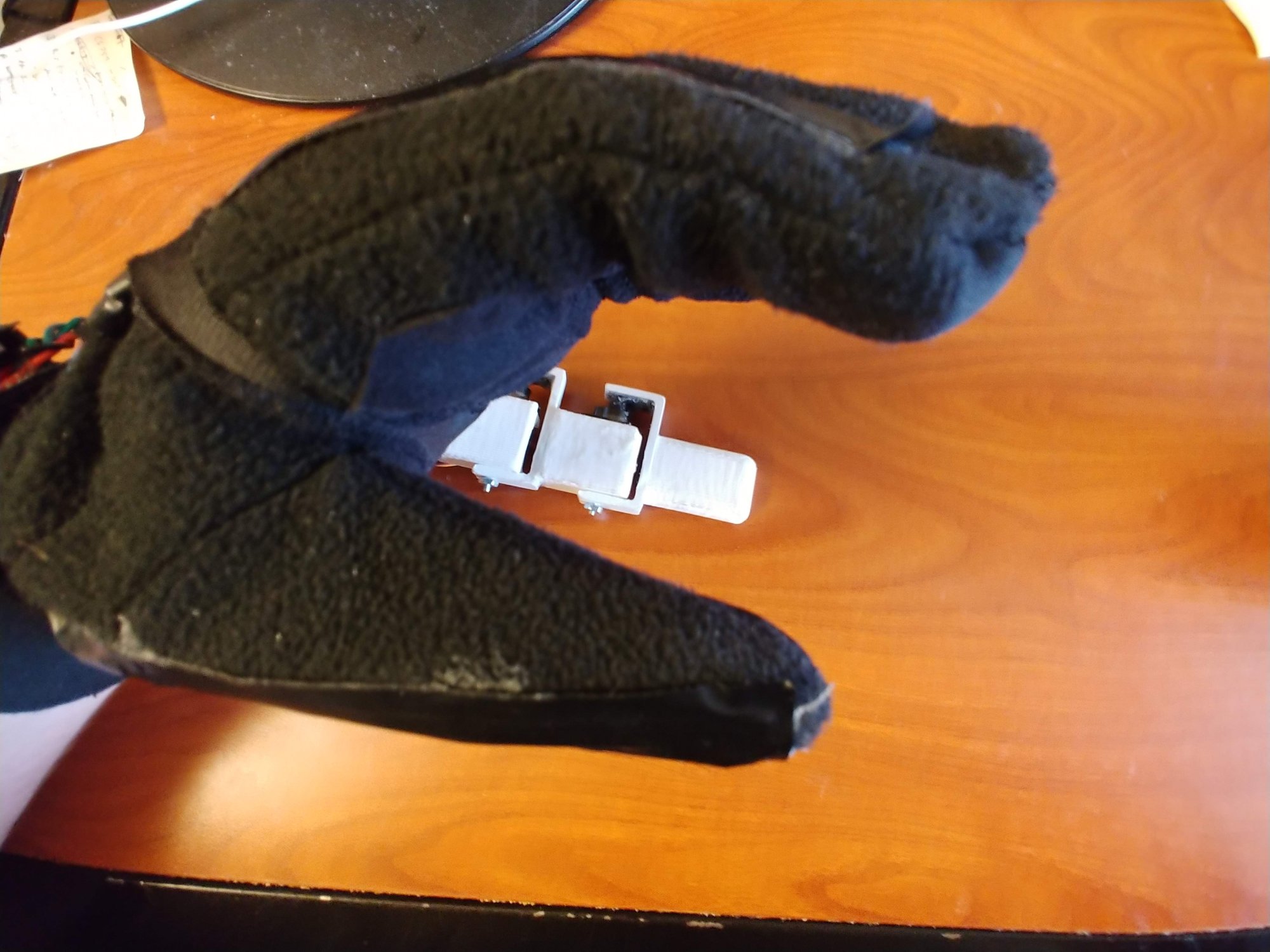
My body was breaking down its own augmentation, which is rather annoying. But hey it makes it an interesting point about adaptation hazards now.
The wall in the training data
There’s one more from the logs. I hit a wall where different grasps produced near-identical flex-sensor signatures while needing completely different joint states. Training data that looked perfectly fine would throw the model off. I filed this under “needs environmental context sensing,” which is true, and which I read as a bug fix when it was the first step up the agency axis.
Breaking my own requirement
My stated design requirement at the time was that the wearer should be able to understand the appendage as a finger or thumb, so they could build on existing grasping knowledge. Control had to capture intention with a high enough signal-to-noise ratio to be actionable without becoming a burden. In other words, make it legible as a tool.
That was the right goal for the course project. Looking back, I was trying to engineer out the most interesting part. Every moment in the previous section (the cabinet, the weirdness, the box, the wall) is a moment where tool legibility failed. Those defects were giving me something for free.
The device has to infer my intent from a signal that doesn’t carry enough information to pin it down. Some fraction of the time it is going to be wrong. A mistake I can predict reads as a broken tool. A mistake I can’t predict looks like the finger wants something.
The oldest version of this problem
That sensation has been produced, and taken apart, with purpose-built apparatus before. In 1853 the craze in London parlors was table-turning. A group of sitters rested their hands on a table, waited, and the table began to move. The sitters were adamant they weren’t pushing. Michael Faraday didn’t buy it and built instruments to check.3
He started by piling a bundle of test plates (sandpaper, millboard, glass, clay, tinfoil, rubber, wood) between hand and table, to rule out any electrical or material explanation. The table turned exactly as before. Then he cemented a few sheets of slippery cardboard together with soft wax pellets, drew a pencil line across their edges, and let the sitters go at it. Afterward the line had sheared, and the top card, the one under the hands, had traveled furthest. The hands moved first and dragged the table along.4
His last instrument was a light lever with a long index needle, arranged so that any sideways drift of the hands registered on the pointer before the table went anywhere. While the sitters couldn’t see the needle, it dutifully reported their hands creeping. The moment he let them watch it, everything went still. The sitters weren’t lying about not pushing. They pushed and did not know they were the source.
I bring this up because it is the same failure of self-attribution, pointed in opposite directions. The table-turners attributed motion to a table when their own hands were the source. I attributed intent to a finger when a voltage sag was the source. Mine happened to someone who had built the thing.
Where this goes
Me in 2019 asked whether I could make an extra finger that feels like mine. A device that passively carried my intent. I am ready to start thinking about purposeful misaligned agentic limbs.
I’m interested in what happens if I build a dial, from fully predictable tool at one end to a digit acting entirely on its own at the other. That dial is the agency axis from the build post, but with a new capacity. Active misalignment, a fourth capacity next to Available, Assist, and Augment. A finger fully permitted to do its own thing. The finger I built during the course lives in the bottom portion of that axis. And there is a cognitive science apparatus for measuring where along that range someone stops experiencing an action as their own.5
Which is where those two details from the folklore come back. The táltos couldn’t learn the gift. It was conferred. Everything I’ve read on wearable augmentation says the opposite. Embodiment is acquired, through practice, and the brain reorganizes to accommodate it. And the bit about losing the power if the extra bone is broken or taken away reads, as far as I can tell, like a folk description of taking the augmentation off. The body has to give the map back.
I picked that name in 2019 because I liked what it said about transcending my own humanity. It turns out the folklore had better research questions in it than I did.
Of course there is also a comfort / usability problem sitting in front of all these interesting agentic capacity questions. I put the finger back on in 2024 and wrote down every place it dug in, and that list, which is not short, is in the build post. Nobody wears a thing like that through a normal day, and the study I want to run only works if someone does.
If you’ve built supernumerary limbs or worn one for any length of time, I’d like to hear about it. Till the next post, go build something.
Footnotes
-
V. Diószegi, A sámánhit emlékei a magyar népi műveltségben [Remnants of shamanistic belief in Hungarian folk culture], Akadémiai Kiadó, Budapest, 1958. Full scan at the Hungarian Academy’s REAL-EOD repository ↩
-
T. Dömötör, Hungarian Folk Beliefs, translated by C. M. Hann, Indiana University Press, Bloomington, 1982. É. Pócs, “The Hungarian táltos and the shamanism of pagan Hungarians. Questions and hypotheses,” Acta Ethnographica Hungarica, vol. 63, no. 1, pp. 149-196, 2018. doi:10.1556/022.2018.63.1.9 ↩
-
M. Faraday, letter to the editor of The Times, June 28, 1853. Reprinted in Experimental Researches in Chemistry and Physics (1859), readable on Wikisource. ↩
-
M. Faraday, “Experimental Investigation of Table-Moving,” The Athenaeum, July 2, 1853. Reprinted in Experimental Researches in Chemistry and Physics (1859), readable on Wikisource. ↩
-
P. Haggard, S. Clark, and J. Kalogeras, “Voluntary action and conscious awareness,” Nature Neuroscience, vol. 5, no. 4, pp. 382-385, 2002. doi:10.1038/nn827 ↩